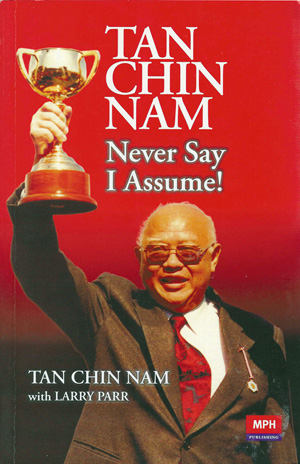
Excerpts from
Datuk Tan Chin Nam's
Never Say I Assume
2006
|
On March 18, 1926, at No. 6 Kamunting Street in Kuala Lumpur, a baby boy named Tan Ah Kow came into the world. He was me - to mangle some grammar but not the fact. Young Ah Kow was the sixth of twelve children (four sons, eight daughters) in the family
My mother, Moh Hooi, was born in 1899, a child from a bomb-throwing revolutionary family fighting against the Manchu Dynasty, which was overthrown in October 1911. This young diminutive fiery beautiful and astonishingly strong-willed Hakka girl began work at age 12 in China, carrying granite bricks to make money and smuggling live grenades to help make a revolution. On August 8, 1915, my mother's father was murdered at a mooncake festival in China by Manchu supporters who were seeking revenge against those who led the revolution.
In Singapore, my mother worked as a courier. She wanted to do good by raising funds for completing the revolution against the Manchus but stayed to do well as a Chinese chanteuse at the Tiong Hiap Heng Hotel, owned by my father. Which is how they met. Although my father was already married and had produced several children, he had the good sense to marry the vital, young songstress in 1916. My life has no hero. It has a heroine. My mother. My name when born, "Tan Ah Kow," was one typically entered into birth records for Chinese males by Malay policemen. My brothers also had that name in the official records. After all, the Chinese parents and grandparents who reported the births to the police could speak neither English nor Malay, and the registrar knew how to write that humble name only in Jawi script. Not long ago, I was walking near by my birthplace, which was also humble. It is in a row of houses located only 10 yards
My first memory is of falling on my head at age one. I was trying to learn how to sit, struggling upwards and then keeling over with a bit of a bonk. My second memory is from the age of five and is a payment on that gaping catastrophe known as the Great Depression. In Singapore, my father had been a successful, mid-level businessman, who was earning what the British left to the locals. He had interests in various businesses including the hotel mentioned earlier, a textile shop, an oil refinery and the only boat ferrying fellow Hokkien Chinese from Fukien to Singapore. Unfortunately, he was also trading in rubber. Black Tuesday, October 29, 1929, was a disaster described by John Kenneth Galbraith
My father lost all of his businesses and gave up, losing the will to survive and surrendered completely to opium. This costly habit would have led to the total breakdown of our family except that in those pre-World War II days, the British had a law allowing addicts, depending on their condition, to buy varying amounts of opium at a controlled price. They could smoke the poison in legalised or at least tolerated opium dens, and they could sell any excess for a profit. After our ruination, we moved first to No. 39 Campbell Road (Jalan Dang Wangi today), just a 10 second walk round the corner. Later we moved to No. 76A Hale Road. The three-bedroom house there was 1,000 square feet and rented for 19 Straits dollars a month. Six to eight or even more family members were usually around the house, and we took in boarders - at one time, six Chinese students, for whom my mother cooked, cleaned, shopped and did laundry the entire day. On some nights there were 15 to 20 people staying in the tiny house. The students slept three each in a couple of 10 foot by 10 foot rooms, while our family members all slept in one 10 foot by 12 foot room. There were no fans.
In our tiny house there were long, loud battles between my mother and father over his opium addiction. Words were screamed that seared all of us to this very day. In great pain from cramping muscles, he would collapse on the ground, shaking, vomiting and purging. By the late 1930s, my mother began to sell her gold jewellery to help make ends meet. When sickness struck, doctors were not an option. We all suffered from intestinal and stomach worms. We were all born at home in the hands of midwives. My mother later trained her daughters to help deliver babies.
I began my education at age five or six, attending the Chinese-medium Lai Meng School in Kampung Baru, which was founded in 1929. It was highly regarded even back then, and keeps its reputation today. I recollect little of my time at the school, though mathematics was said to be my best subject. Although my mother was well-educated, coming from a politically active family in China, and although my father could read and write Chinese excellently, they knew not a word of English or Malay. My mother was a humanist in the truest sense. She understood that education was essential for the future of her children and that at least one of us must receive not only a Chinese education but an English one as well. The British ran Malaya, and most of the big jobs were for those who could speak the King's tongue. In 1932, my mother forced my father, after many battles, to take me to the Batu Road School, one of three feeder schools then, along with Maxwell and Pasar Road schools, for the Victoria Institution, or V.I., the most prestigious school in Kuala Lumpur.
The day I entered Batu Road School was the day I ceased to be generic Tan Ah Kow. I became Tan Ah Hock because the registrar misunderstood the Jawi script in which my name appeared on my birth paper. After spending 1932 and 1933 in Primary One and Two at Batu Road School, I stayed on to do Standards One through Five. By this time, my mother must have clearly comprehended that a purely Chinese education was a dead end because she insisted that I spent, not one year but two years, 1938 and 1939, in Standard Five at BRS, so as to ensure that my school tests would yield enough of the coveted A's to ensure entry into Standard Six at the V.I.
My most exciting memory of this period was not what happened in school but on the way to school. I had to walk through villages and secondary jungle to reach Batu Road School. There was a short cut which involved crossing Sungai Bunus, a tributary of the Klang River. The bridge was a round, 18 inch water pipe, access to which was prevented by coiled barbed wire. I still have barbed wire scars on my arms and left leg near the knee to mark my successes. Whether the river far below was shallow in thirst during the dry season or swollen in anger during the monsoon, I know for a fact that I never once slipped off the pipe while taking tiny steps across it with my arms and hands extended shoulder height for balance. A fall would have banged me up badly during the dry season or possibly drowned me during the monsoon, for I could not swim a stroke! An unhappy aspect at BRS was bullying. My recollection is that I was twelve and I had a Chinese boy
On one of those days, during the school break, the ragging
became too much.
Crime and drugs passed by most of us kids. Old Malaya was a safe place not only for Somerset Maugham's white men but also for us. In 1935 there were only 13 murders in Singapore and this type of crime was similarly rare in Kuala Lumpur. My mother had the great heart and good sense to permit her children a childhood despite our poverty. She never insisted that I or my brothers and sisters
My mother, who was without a moment of freedom during an average day, could not keep track of us. Instead of studying, I sometimes sneaked away to spend a warm and dusty afternoon with friends, searching for spiders and catching worms to feed our fish in mock battle. Perhaps she did not look too hard for me, sensing that before I could be expected to fight for survival in adulthood, I had to have some happiness in childhood. I recollect that these "lazy, hazy, crazy days of summer" came to an end after entering the Victoria Institution in late 1939. The school fees were high, but my mother beat down resistance from my father by sheer force of will, arguing that a future for me in the world of English-speaking business was a wise investment for the family.
Founded in 1893, the V.I. was indeed the bridge across the gulf between the world of the Malayan Chinese and the British "heaven born," which was the word to describe the men of cheese back then. I was the only child in the family to attend this school or even proceed beyond Chinese medium education. If the history of the English-speaking peoples, as Winston Churchill wrote in a four volume work of the same title, has been a slow, yet steady rise of the individual, then I felt a pride in my soul when I first entered the Victoria Institution, dressed rather grandly,
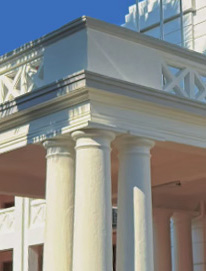
As I climbed up what was then called Petaling Hill, which was not far from what would become Merdeka Stadium, my eyes scoured the large playing field in front of a single, long, white-washed, two-storey main building in the style of so many British public schools. As I walked through the main entrance, commanded by a tower above, I was fascinated by the doric columns, which were severely plain, and by the unadorned triangular pediment above the columns. A Malayan Pathenon? I might have become a so-called "banana," an Englishman in Chinese disguise, except
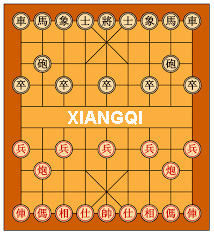
An English education in that period meant work. As a pupil at BRS, I had played draughts and was school champion for two years running. At the V.I. I continued playing that game and xiangqi, the Chinese version of that game. Not coincidentally my strongest subject at the V.I. was geometry, followed by mathematics, and chess is a game about formulating strategies involving spatial relationships. My English improved noticeably. There was English Literature to master and Latin was on the horizon. I took pride in my schoolwork in the spirit of the Chinese saying, "Your own essay is like other people's wives," whom we imagine to be perfect. In a progress report, one of my teachers wrote that I was unfailingly cheerful and always ready with a joke. And the truth was that I was happy.
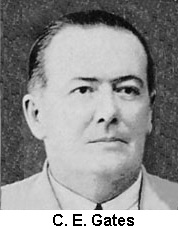
One remembers pageants at the V.I. whenever there were celebrations of the British Empire. The shows ended with the entire school - brown, yellow and black under the satisfied eye of Mr C. E. Gates, the white headmaster - standing to sing "God Save the King." It was classic pukka in the tradition of the public school.
I knew that my mother and sisters were working ever harder to pay my school fees. Our family diet began to suffer. My mother made biscuits with coconut butter, ever smaller amounts of sugar and bread rind. Nothing went to waste, including our clothes. I wore hand-me-downs and must have appeared ragged in the eyes of my school friends. It was at about the time World War II began that
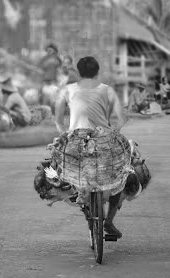
But doing what? Business, of course. With my eldest half-brother, Tan Siew King, I went out to Dusun Tua and Kampung Baru to collect chickens, which I then resold in villages and along the roadside in the town proper. On the first day of this new life, my former fellow students at the V.I. saw me, and to this very minute, I am ashamed to say that I was humbled or malu, even though I was doing honest labour. To my mother's credit - for she had instilled in me what the West calls the "Protestant ethic" and what the Chinese call respect for thrift and hard work - my mood did not last long. One hot Malayan afternoon, a moment I can still capture in my mind's eye, I was pedalling my bicycle through a village. Chickens were squawking in a cage on the back fender of the bike. I had on a singlet, a pair of shorts, and a couple of woven sandals - the proper dress for a classic pukka Chinese business boy, who had just learned the best sales pitch for selling chickens. "Ayam! Ayyie-Yaaaaam!" I shouted happily while wheeling along the dusty red road......
Also see: Datuk Tan Chin Nam - Master in Business and Chess   The V.I. Web Page
|
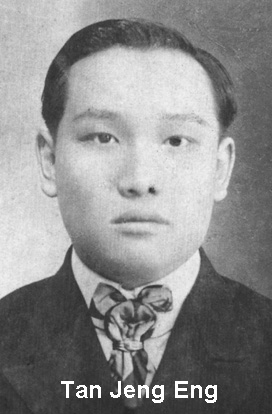 of Tan Jeng Eng and Choo Moh Hooi. Tan was a Malayan businessman and rubber trader born in 1886 in the
village of Eng Choon in China's Fukien Province.
of Tan Jeng Eng and Choo Moh Hooi. Tan was a Malayan businessman and rubber trader born in 1886 in the
village of Eng Choon in China's Fukien Province. 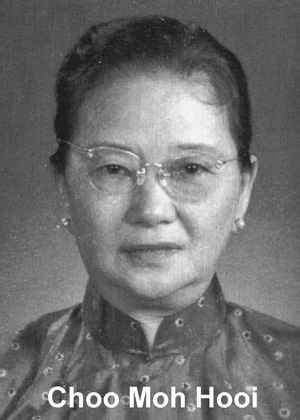 My mother's entire family seemed slated for assassination, which was the immediate cause for family members shipping out to Singapore.
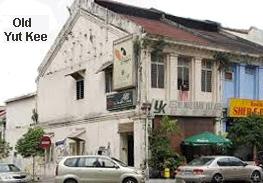 behind the original Yut Kee coffee shop along Campbell Road, which opened in 1928 and is renowned for its butter and roasted coffee. The terrace houses in that row are in good repair except for Nos. 6 and 6A.
  as "the most devastating day in the history of markets." My father in low-rise colonial Malaya some 12,000 miles away got caught in the horror. Tin and rubber were the twin gods of Malayan wealth. Now the markets for both collapsed.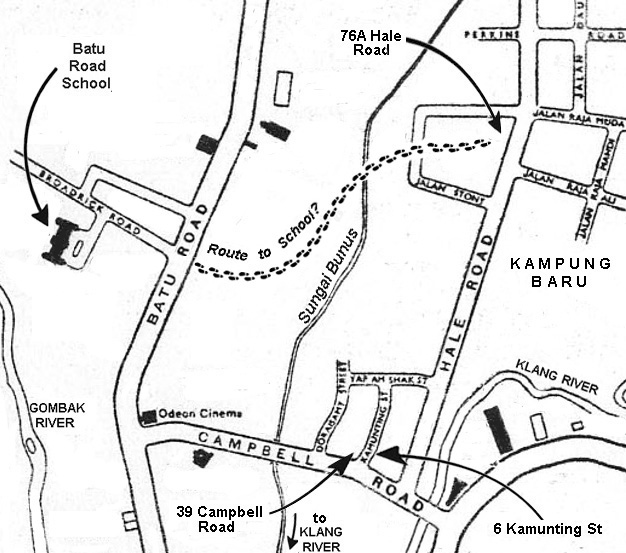
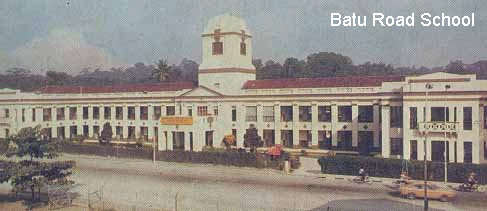
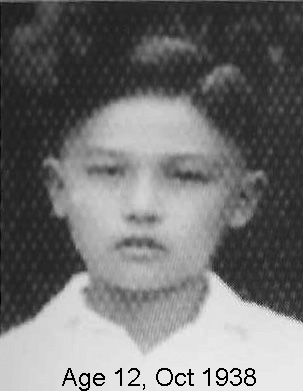 Mathematics was a strong subject at BRS, and my English was probably improving a bit.
 to battle. He was bigger, stronger, faster, meaner and probably jealous of my school performance.
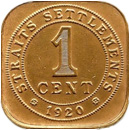
At 11 a.m. every school day, we pupils adjourned to the tuck shop. On alternate days, I received a
Straits Settlements red copper cent with which I bought an enormous ice ball of shaved ice doused
in syrup as well as a piece of cake.
to battle. He was bigger, stronger, faster, meaner and probably jealous of my school performance.
At 11 a.m. every school day, we pupils adjourned to the tuck shop. On alternate days, I received a
Straits Settlements red copper cent with which I bought an enormous ice ball of shaved ice doused
in syrup as well as a piece of cake. 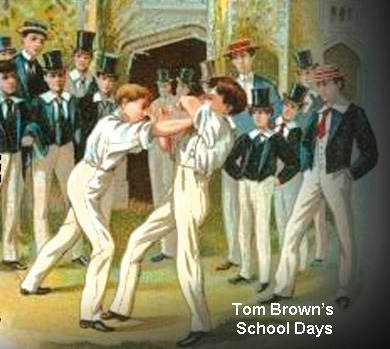 In maddened anger, I saw red. I preferred death at that moment to enduring further bullying, and challenged my adversary to a fight. Some forty boys made a circle around us, whereupon the bully belted me all over until I was laid out in the red laterite dust. He asked me to surrender, but I got up and continued getting whipped until he lacked the courage to continue punishing me. Which, by the way, is what happened to young Tom Brown and the bully Flashman at Rugby School. For the baiting came to an end.
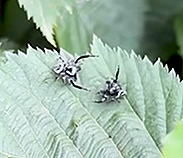 worked half as hard as she did. We spent our youth ever so innocently. We played blood sports such as fighting cocks, fighting fish, fighting spiders, as well as marbles, rounders and tops. We swam at Dusun Tua and Klang Gates. Animals were everywhere, and since we slaughtered our own food, we knew whence it came. Every house kept chickens which were fed leftover rice. Our "night soil," or human waste, was used in the garden. Nor was our garbage wasted. A man collected it daily to use as swill for pigs.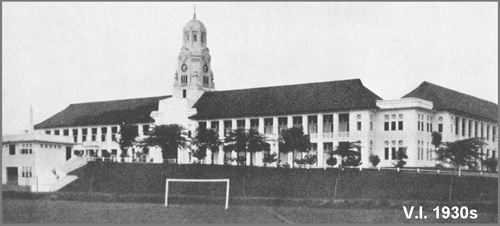
 I thought, in a white shirt.
 that our family financial problems would soon come to coincide with that enormous patch of bother
called World War II, when Churchill's dignity of the individual did not fare too well.
that our family financial problems would soon come to coincide with that enormous patch of bother
called World War II, when Churchill's dignity of the individual did not fare too well. 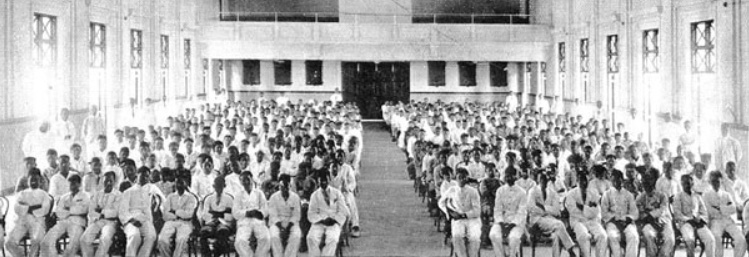
 I remained at the V.I. all the way through Standard Seven (Form Three today) until 1941. My political consciousness was low, though at that time, I knew the name of Chiang Kai-Shek, whom I must have viewed as the valiant leader of wartime China after the Japanese attack at Marco Polo Bridge in July 1937. Of course, I had no inkling that this war would soon overtake the lives of all of us. Instead, I had a personal consciousness.
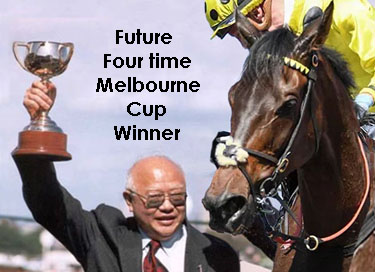 my mother finally told me that my days as an English schoolboy were over. She could not pay the fees. I had to go to work.